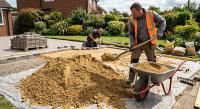
How to Calculate the Right Quantity of Aggregates for Your Next Job
Working out how much aggregate you need is an important step in any building, landscaping or driveway project. Ordering too little causes delays, while ordering too much increases costs and storage issues. This guide explains how to calculate the correct quantity, convert it into tonnes, and order with confidence.

1. Measure the Area
Start by measuring the length and width of the space where the aggregate will be used. Keep all measurements in metres:
-
Measure length (m)
-
Measure width (m)
If the area is an odd shape, break it into smaller rectangles, measure each section, and add the results together.
2. Choose the Correct Depth
Depth depends on the type of project and the material being used:
|
Application Type |
Recommended Depth |
|
Paths & driveways |
50mm (0.05m) Max |
|
Decorative garden areas |
30–50mm (0.03–0.05m) |
|
Drainage and sub-base layers |
100–150mm (0.1–0.15m) |
Make sure you convert millimetres into metres before calculating:
50mm = 0.05m / 100mm = 0.1m
3. Calculate the Volume in m³
Use this simple formula:
Volume (m³) = Length (m) × Width (m) × Depth (m)
Example:
Length: 5m
Width: 3m
Depth: 0.05m
5 × 3 × 0.05 = 0.75m³
This is the amount of material needed in cubic metres.
4. Convert to Tonnes
Aggregates are normally supplied in tonnes or bulk bags, so the next step is to convert your m³ calculation into an approximate weight. Different materials have different densities:
|
Material Type |
Average Density (tonnes per m³) |
|
1.6–1.8 t/m³ |
|
|
1.5–1.7 t/m³ |
|
|
Crushed stone |
1.4–1.6 t/m³ |
|
1.9–2.1 t/m³ |
Example using gravel at 1.7 t/m³:
0.75m³ × 1.7 = 1.275 tonnes
Round up slightly to allow for compaction, spillage and levelling, so you would order around 1.3 tonnes.
If ordering bulk bags, each bag is usually around 850kg to 1 tonne, depending on the product.
5. Use the Mainland Aggregates Quantity Calculator
To save time, you can enter your measurements into the free calculator on our website. Choose your material, enter length, width and depth, and the tool will estimate how many tonnes or bulk bags to order. This helps reduce waste and ensures you order the right amount first time.
6. Ask for Expert Guidance
If you’re not sure which material is best for the job, or whether your depth is correct, our team can help. At Mainland Aggregates, we supplied a full range of decorative aggregates and quarried aggregates, and much more. Therefore, we’re also happy to help with any of your questions before you order.
Conclusion
Working out how much aggregate you need doesn’t need to be complicated. Measure the area, convert the depth, calculate volume, and then convert to tonnes based on the material you’re using. By following these steps or using our online calculator, you can order confidently, avoid delays, and stay within budget.
For accurate estimates and high-quality materials delivered nationwide, shop with us at Mainland Aggregates today.
IMPORTANT NOTICE – DOES NOT APPLY TO LOOSE DELIVERIES
- Orders are delivered by an 18t rigid vehicle with a tail-lift and manual pump trolley.
- A level tarmac, concrete, or block-paved area is required for unloading; the trolley cannot operate on grass, gravel, or slopes.
- The lorry (10m L x 2.8m W x 4m H) does not have a HIAB crane and cannot lift over fences/hedges or deposit bags on grass or gravel.
- Customers must ensure access roads and the unloading site are suitable for the vehicle. Inform us immediately of any access issues at 01234 831108
- Delivery guarantees kerbside only, though drivers will try to place orders in the required area.
- HIAB crane delivery is available for orders of 10+ bags/pallets at extra cost.