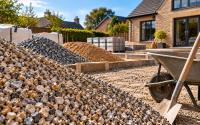

To work out how much gravel you need, measure the length, width and depth of the area, then multiply them together to calculate the volume.
The important part is choosing the right depth. A decorative garden border does not need the same build-up as a driveway, patio base or shed foundation. That is why it is better to calculate gravel by project rather than relying on one generic coverage figure.
You can also use our gravel calculator to enter your measurements and estimate how much material you need before ordering.
How do I calculate how much gravel I need?
You calculate gravel by multiplying the area by the required depth.
For example, if an area measures 10ft x 6ft (3m x 1.8m) and needs gravel laid at 2 inches (50mm) deep, the calculation is:
That means you need roughly 0.27 cubic metres of gravel before allowing for uneven ground, compaction or waste.
| Measurement | Example |
|---|---|
| Length | 10ft (3m) |
| Width | 6ft (1.8m) |
| Depth | 2 inches (50mm) |
| Approximate volume | 0.27m³ |
For a quicker estimate, use a gravel calculator to convert your measurements into the amount of gravel needed in bulk bags, tonnes or cubic metres.
How much gravel do I need for a driveway?
A gravel driveway usually needs a compacted sub-base of around 4–6 inches (100–150mm), with a gravel surface layer of around 2 inches (50mm).
The sub-base provides strength for vehicles, while the top layer creates the finished driveway surface. If you are only topping up an existing gravel driveway, you may only need the surface layer. For a new driveway, you will usually need both the sub-base and the decorative or functional gravel finish.
| Driveway layer | Typical depth | Why it matters |
|---|---|---|
| Sub-base | 4–6 inches (100–150mm) | Provides strength and stability under vehicle weight |
| Gravel surface layer | 2 inches (50mm) | Creates the visible driveway finish and supports drainage |
| Driveway top-up | 1–2 inches (25–50mm) | Refreshes an existing gravel surface |
A driveway measuring 16ft x 10ft (5m x 3m) with gravel laid at 2 inches (50mm) deep would need around 0.75m³ of surface gravel. A full new driveway would also need a deeper sub-base beneath it.
How much gravel do I need for a patio or paving base?
A patio or paving area usually needs a compacted sub-base of around 3–4 inches (75–100mm), followed by a bedding layer of around 1–2 inches (25–50mm).
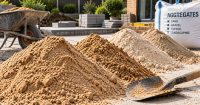
Gravel is not always the visible finish on a patio, but aggregate is still important underneath. MOT Type 1 is commonly used to form a stable sub-base, while sharp sand or grit sand can be used as a bedding or levelling layer depending on the paving system.
| Patio / paving layer | Typical depth | Why it matters |
|---|---|---|
| MOT Type 1 sub-base | 3–4 inches (75–100mm) | Creates a firm foundation for paving |
| Bedding layer | 1–2 inches (25–50mm) | Helps level paving slabs or blocks |
| Joint filling aggregate | Product-specific | Used between permeable block paving joints |
For a patio measuring 13ft x 10ft (4m x 3m) with a 4 inch (100mm) sub-base, you would need around 1.2m³ of sub-base material before allowing for compaction.
How much gravel do I need for a garden path?
A garden path usually needs gravel laid at around 2 inches (50mm) deep, with a sub-base added for heavier use.
For a light decorative path, gravel alone may be enough if the ground is firm and well prepared. For a main garden route, side access path, bin route or shed path, a compacted sub-base helps stop the gravel sinking, spreading or becoming uneven.
| Path type | Typical depth | Best for |
|---|---|---|
| Light decorative path | 1.5–2 inches (40–50mm) | Occasional foot traffic |
| Regular garden path | 2 inches (50mm) | Everyday walking routes |
| Heavier-use path | 2 inches (50mm) gravel over a compacted sub-base | Bins, wheelbarrows, shed access |
| Self-binding gravel path | Product-specific | Firmer natural-looking paths |
A path measuring 20ft x 3ft (6m x 0.9m) at 2 inches (50mm) deep would need around 0.27m³ of gravel.
How much gravel do I need for a decorative garden area?
Decorative garden gravel is usually laid around 1.5–2 inches (40–50mm) deep.
This is normally enough to cover soil or membrane evenly and create a clean decorative finish. Decorative gravel is often used in borders, around planters, in front gardens, around paving and in low-maintenance landscaping schemes.
| Decorative use | Typical depth | Why it matters |
|---|---|---|
| Garden borders | 1.5–2 inches (40–50mm) | Covers soil and improves appearance |
| Around planters | 1.5–2 inches (40–50mm) | Creates a neat decorative finish |
| Front garden gravel | 2 inches (50mm) | Gives better coverage over larger visible areas |
| Seating areas | 2 inches (50mm) plus base if needed | Helps create a cleaner, more stable surface |
A decorative area measuring 10m² at 2 inches (50mm) deep would need around 0.5m³ of gravel before allowing for uneven ground or waste.
How much gravel do I need for a shed or garden office base?
A small shed base may need around 3–4 inches (75–100mm) of compacted aggregate, while a larger garden office may need 4–6 inches (100–150mm) or more depending on the structure.
The heavier the building, the more important the base becomes. A lightweight shed may sit on paving slabs over a compacted base, while a larger garden office may need a deeper sub-base, concrete pad or more carefully specified foundation.
| Base type | Typical aggregate depth | Best for |
|---|---|---|
| Small shed base | 3–4 inches (75–100mm) | Lightweight sheds and simple slab bases |
| Larger shed base | 4 inches (100mm) or more | Heavier timber sheds |
| Garden office base | 4–6 inches (100–150mm) or project-specific | Larger, heavier garden buildings |
| Gravel grid base | Product-specific | Free-draining shed or garden building bases |
For a shed base measuring 8ft x 6ft (2.4m x 1.8m) with a 4 inch (100mm) aggregate layer, you would need around 0.43m³ of sub-base material.
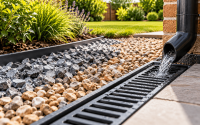
How much gravel do I need for drainage?
Drainage gravel is project-specific, but simple drainage strips may use around 2–4 inches (50–100mm) of gravel, while French drains and soakaways need to be sized around the trench, pipe and water volume.
Unlike decorative gravel, drainage aggregate is not just about surface coverage. It needs enough depth and space around the pipe or drainage area to allow water to move through the material properly.
| Drainage project | Typical gravel depth | Why it matters |
|---|---|---|
| Surface drainage strip | 2–4 inches (50–100mm) | Helps move water away from paths, patios or walls |
| French drain | Project-specific trench depth | Gravel surrounds the perforated drainage pipe |
| Pipe bedding | Project-specific | Supports and protects drainage pipework |
| Soakaway | Project-specific | Needs correct sizing for water volume and ground conditions |
For drainage projects, clean gravel or shingle is usually more suitable than decorative stone with lots of fine particles, because water needs to pass through freely.
Why does gravel depth change by project?
Gravel depth changes because each project needs the material to do a different job.
A garden border only needs enough gravel to cover the ground. A driveway needs to support vehicle weight. A patio needs a firm base below the paving. A drainage trench needs enough clean stone to let water flow. A shed or garden office base needs stability to reduce movement over time.
| Project | Typical depth guide | Main purpose |
|---|---|---|
| Decorative border | 1.5–2 inches (40–50mm) | Appearance and ground coverage |
| Garden path | 2 inches (50mm) | Walkable surface |
| Driveway surface | 2 inches (50mm) | Vehicle-suitable gravel finish |
| Driveway sub-base | 4–6 inches (100–150mm) | Strength and load bearing |
| Patio sub-base | 3–4 inches (75–100mm) | Stability beneath paving |
| Shed base | 3–6 inches (75–150mm) | Firm foundation |
| Drainage gravel | Project-specific | Water movement |
This is why a gravel calculator is most useful when you already know the correct depth for your project.
Should I order extra gravel?
Yes, it is sensible to order slightly more gravel than the exact calculation suggests.
Ground is rarely perfectly level, and some material may be lost through spreading, compaction or uneven areas. This is especially true for driveways, paths, sub-bases and larger landscaping projects.
As a practical guide, consider allowing a small extra margin for:
- Uneven ground
- Compaction
- Edges and awkward shapes
- Spreading losses
- Future top-ups
For decorative areas, the margin may be small. For driveways and sub-bases, it is more important to avoid running short partway through the job.
FAQs
How deep should gravel be laid?
Gravel is often laid around 2 inches (50mm) deep for decorative areas, paths and driveway surface layers. Driveways, patios and shed bases usually need a deeper compacted sub-base underneath.
How much gravel do I need for 10 square metres?
For 10m² laid at 2 inches (50mm) deep, you need about 0.5m³ of gravel before allowing for compaction, waste or uneven ground.
How much gravel do I need for a driveway top-up?
For a driveway top-up, you may only need around 1–2 inches (25–50mm) of gravel, depending on how much existing material is still in place.
Do I need a sub-base under gravel?
You usually need a sub-base under gravel for driveways, patios, shed bases and heavily used paths. Decorative borders and light garden areas may not need one if the ground is stable.
How much does a bulk bag of gravel cover?
A bulk bag’s coverage depends on the bag weight and the depth you lay the gravel. It will cover more area at a shallow decorative depth than it will for a deeper driveway or base layer.
Can I use the same gravel depth for every project?
No. Decorative areas, paths, driveways, drainage jobs and shed bases all need different depths because the gravel is doing a different job in each case.
What is the easiest way to work out how much gravel I need?
The easiest way is to measure the project area, choose the correct depth, then use a gravel calculator to estimate the amount needed in bulk bags, tonnes or cubic metres.