How to Order Aggregates for a Large Construction Project
Whether you’re working on a one-off project or you work in the construction industry, managing a large construction project involves making sure that the materials keep coming. The last thing you want is for a project to be held up because you are unable to source materials in a timely manner. Not only that, but you need to make sure you remain under budget. Balancing all of this isn’t always the easiest, but it is essential, which is why you want to make sure you have a supplier you can rely on and know that you can source the materials as and when you need them.
Key Summary
- Accurate Material Estimation Is Essential: Calculate total volume in cubic metres (L × W × D), multiply by the material’s specific density (typically 1.8 to 2.2 tonnes/m³), and factor in a 10–20% contingency for compaction and site waste.
- Sub-Base Selection Depends on Drainage & Load: Use coarse capping layers like 6F2 aggregate or 6F5 aggregate for budget-friendly bulk site fill and sub-bases. For permeable, SuDS-compliant paving sub-bases where minimal fines are required, opt for MOT Type 3.
- Match Sands & Mixes to the Application: Specify building sand for smooth bricklaying mortar, construction sand (sharp sand) for floor screeds and block paving bedding, and ballast for strong, high-volume concrete footing pours.
- Plan Site Logistics in Advance: Large commercial projects benefit most from loose aggregate deliveries carried by 8-wheel tippers or articulated lorries. Ensure ground conditions, overhead hazards, and turning circles are audited prior to scheduling rolling deliveries. See delivery information.
Planning & Quantity Estimation
When you are running a large construction project, planning is essential if you want everything to run smoothly. This means planning what materials you’ll need and being able to order them in advance to avoid unnecessary delays.
However, on top of that, part of your strategy also needs to involve working out how much material you need. You want to avoid not having enough materials which could cause a delay in completing your project. However, you equally want to make sure that you don’t over-order materials. Not only will this eat into your budget, but can leave you with a problem of getting rid of materials that you haven’t been able to use.
Calculating your aggregate needs begins with measuring the overall footprint in metres—length, width, and required depth—to establish the cubic volume (m³). Since aggregates are sold by weight, you must then convert this volume using the material’s bulk density factor, which typically ranges between 1.8 and 2.2 tonnes per cubic metre depending on the material. Crucially, always factor in an additional 10% to 20% contingency to allow for site compaction, ground absorption, and general wastage during groundworks.
Selecting the Correct Aggregates
Part of your preparation needs to involve planning what materials you require and at what stage of your project you’re going to need them.
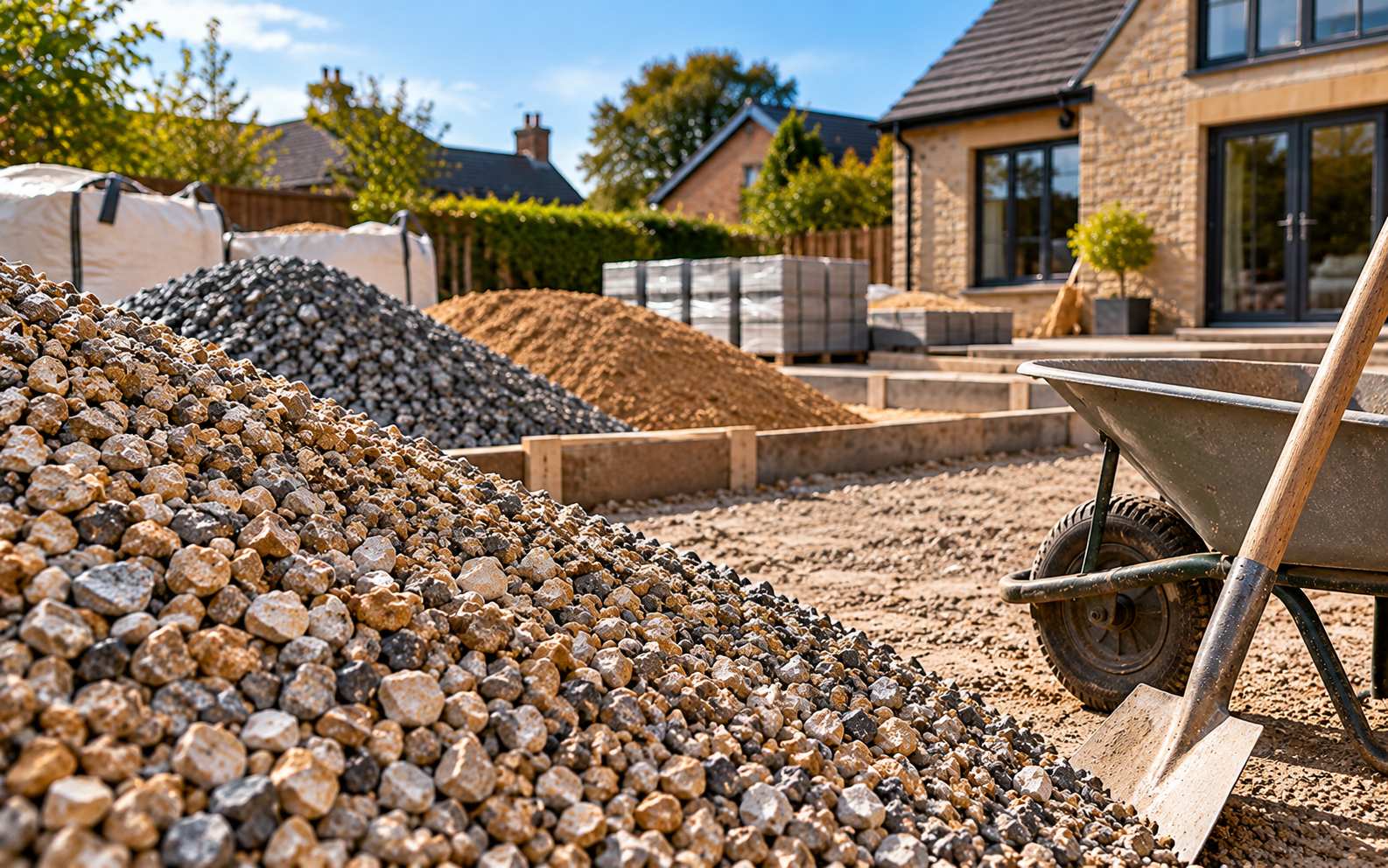
For heavy-duty sub-bases, haul roads, and initial capping layers, coarse recycled materials like 6F2 aggregate or quarried 6F5 aggregate offer an exceptional, cost-effective base. Where sustainable drainage (SuDS) or permeable paving is required, MOT Type 3 provides a reduced-fines unbound layer that allows free water movement while maintaining load-bearing strength. You can also explore the range of permeable aggregates for SuDS.
On top of that, consider what sand you are going to need – whether you need sand for bricklaying or construction sand for screeding and/or paving, for example. Mainland Aggregates offers building sands and ballast alongside sharp sand.
Logistics & Site Delivery
Once you have a plan of exactly what you need and when you need it, it is time to work out the logistics of how to get the material to you. Depending on the project size, you may need to speak to your project manager and work out access routes, taking into account ground stability, overhead cables and even space for getting vehicles in and out of the site.
Large-scale developments benefit most from loose aggregate deliveries, which provide maximum cost efficiency and high-volume delivery per load. Depending on site layout and access limits, materials are typically delivered using 8-wheeler tippers carrying up to 20 tonnes or grab lorries capable of placing loads over perimeter barriers. Review the available options in our delivery information.
Quality Control
It stands to reason that for large projects, compromising on material quality is not something that you can consider. All structural aggregates should comply with relevant UK standards and Highway Specifications (SHW) to guarantee consistency, strength, and safety under heavy loads.
Partnering with a reliable UK supplier like Mainland Aggregates ensures that every load arriving on-site meets strict quality certifications while supporting your project’s sustainability goals.
How to Order Aggregates for a Large Construction Project – FAQs
How do you calculate how much aggregate you need for a construction project?
Calculate the volume by multiplying the length, width, and depth in metres to get the total volume in cubic metres (m³). Length (m) × Width (m) × Depth (m) = Volume (m³). Convert volume to weight by multiplying the total cubic metres by 1.9, the average bulk density factor for most aggregates. Volume (m³) × 1.9 = Weight in Tonnes. Allow an additional 10% to 20% for compaction, ground absorption and general wastage.
What type of aggregate is best for a construction project?
It depends on the structural application:
- Sub-Bases & Bulk Fill: 6F2 or 6F5 aggregate for budget-friendly capping layers and haul roads; MOT Type 3 for permeable, SuDS-compliant sub-bases.
- Concreting: Ballast (sharp sand and gravel) for structural foundations and footings.
- Mortar & Screeds: Building sand for bricklaying mortar; construction sand (sharp sand) for floor screeds and paving bedding.
How is bulk aggregate delivered to a construction site?
Bulk aggregates are delivered loose using 8-wheeler tippers carrying 16–20 tonnes or articulated trailers carrying up to 30 tonnes, tipped directly into stock bays. For sites with tight access or perimeter walls, grab lorries carrying 12–16 tonnes can drop material over obstacles, while bulk bags are available for restricted offloading areas. Check the delivery information for details.