
If you are investing the time, effort and money to install a new gravel driveway, it makes sense to get the foundations right. A driveway needs to support the weight of vehicles, resist rutting and provide a stable surface for everyday use.
There is no single excavation depth that suits every property. The amount of digging required depends on the existing ground, the depth of the topsoil, the vehicles using the driveway and the finished levels you want to achieve.
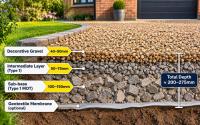
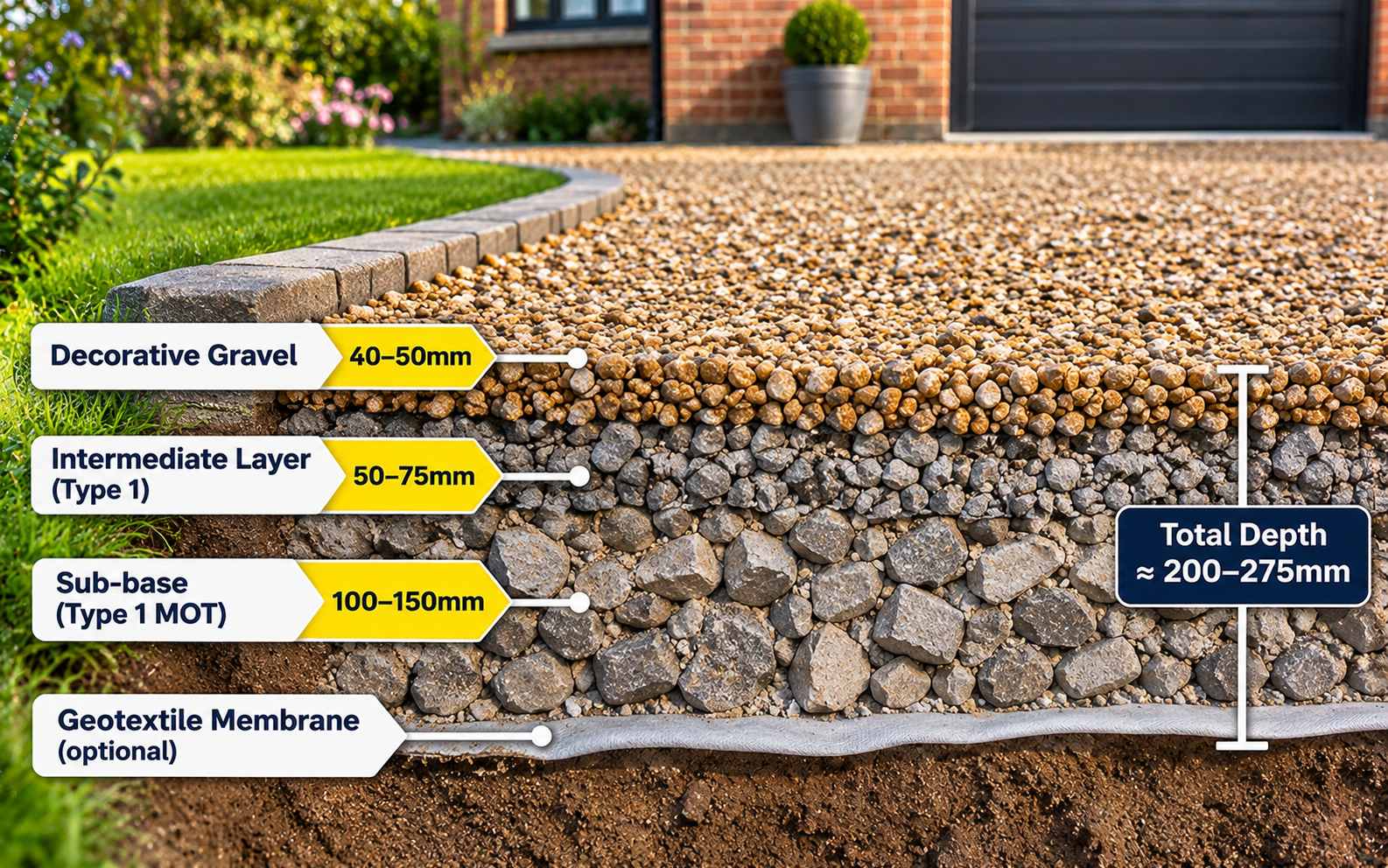
As a general guide, a domestic gravel driveway should have a compacted sub-base of at least 100mm, with 150mm preferred for areas carrying cars. The decorative gravel layer should be no more than 50mm deep. The topsoil must also be removed, with any additional excavation determined by the ground conditions and required construction depth.
Key Summary
- Excavation: Remove the topsoil and any unsuitable or soft material until you reach a suitable subgrade. The total excavation depth will vary from site to site.
- Sub-base layer: Allow at least 100mm of compacted sub-base, with 150mm generally preferred for a domestic driveway carrying cars.
- Surface gravel: Aim for a finished depth of up to 50mm, using a suitable driveway gravel, commonly around 20mm in size.
- Geotextile membrane: Where ground conditions require it, install a suitable membrane between the excavated ground and the sub-base.
- Material quantities: Calculate each layer separately and use the density of the specific aggregate rather than relying on one figure for every material.
Preparing the Ground (The Subgrade)
Much like any other construction project, the first priority is preparing a suitable foundation. The subgrade is the existing ground beneath the driveway, and its condition has a significant influence on how well the finished surface performs.
Start by removing grass, roots, loose soil and topsoil until you reach firm subsoil. Topsoil contains organic material and can retain water, making it unsuitable as the foundation for a driveway that needs to support vehicles.
The depth of topsoil varies considerably between properties, so it is not possible to prescribe one excavation depth for every driveway. Once the topsoil has been removed, inspect the exposed ground. Any soft areas should be excavated further and made up with suitable compacted sub-base material.
A geotextile membrane can also be used as a separation layer where ground conditions require it. Its purpose is to help prevent the sub-base from mixing with the underlying soil while allowing water to pass through. The membrane should be laid between the excavated ground and the sub-base, rather than directly underneath the decorative gravel.
Mainland Aggregates supplies a range of geotextile membranes for driveway and groundworks applications.
Important: Before excavating, identify the position and depth of any buried services, including water, gas, electricity, drainage and telecommunications. If you are unsure where services are located, seek professional advice before starting work.
Building Structural Strength (The Sub-Base)
Once the ground has been prepared, the next stage is installing the sub-base. This is the most important structural layer of a gravel driveway. It helps distribute the weight of vehicles across the ground below and provides a firm foundation that reduces the risk of rutting and movement.
For a typical domestic driveway, allow a minimum compacted sub-base depth of 100mm. A depth of 150mm is generally preferred where the driveway will carry cars. Heavier vehicles, poor ground conditions or particularly demanding use may require a deeper or specially designed construction.
Choosing the Right Sub-Base Aggregate
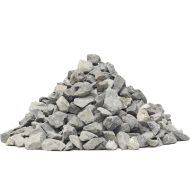
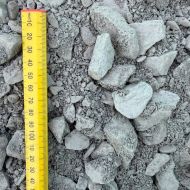
MOT Type 1 is a commonly used choice for gravel driveway sub-bases. It consists of crushed aggregate graded from 40mm down to dust. The range of particle sizes allows the material to interlock when compacted, creating a dense and stable foundation.
MOT Type 3 is another option where a more open-graded, reduced-fines material is required. It has a lower fines content than Type 1, allowing water to pass through more freely. It is used in applications where drainage through the sub-base is an important consideration.
However, choosing Type 3 does not automatically make an entire driveway compliant with a particular Sustainable Drainage System (SuDS) design. The surface, sub-base, ground conditions and wider drainage arrangements all need to work together. If drainage performance or compliance is a project requirement, the complete construction should be designed accordingly.
Whichever material you choose, spread and compact the sub-base in manageable layers using suitable compaction equipment. Follow the material and project specifications to ensure that the full depth is properly compacted, rather than simply compacting the surface.
Getting the Finish Right (Surface Gravel Depth)
Once the sub-base has been installed and compacted, you can add the decorative gravel. This is the visible surface of the driveway and provides the finished colour and appearance.
For a gravel driveway, a finished surface depth of up to 50mm is a useful general guide. The purpose of this layer is to provide a decorative finish, rather than structural support. Adding considerably more gravel does not improve the strength of the driveway and can make it harder for vehicles to move across the surface.
A gravel size of around 20mm is commonly recommended for driveways. Smaller stones can become caught in vehicle tyres, while much larger stones may be less comfortable to walk or drive over. Angular chippings can also provide a more stable surface than rounded gravel, although the best choice will depend on the product and the appearance you want.
Mainland Aggregates supplies a wide range of decorative gravels and chippings in different colours, sizes and materials, allowing you to choose a finish that complements your property.
For driveways that are sloped or experience regular turning and manoeuvring, a gravel stabilisation grid may also be worth considering. These systems help hold the surface aggregate in place and can reduce movement under traffic. Always check that the grid is suitable for the intended vehicle loading and install it in accordance with the manufacturer's instructions.
Settlement and Calculating Material Quantities
Ordering the correct quantity of aggregate is an important part of planning a driveway project. Order too little and the installation may be delayed; order too much and you could be left with unnecessary material.
Start by measuring the driveway's length and width in metres. Multiply these measurements to calculate the area, then multiply the area by the required layer depth in metres to calculate the volume.
Volume (m³) = Length (m) × Width (m) × Depth (m)
For example, a driveway measuring 5m by 4m has an area of 20m². If you are calculating the volume of a 150mm sub-base layer, convert the depth to 0.15m:
20 × 0.15 = 3m³
This gives you the estimated volume before converting it into tonnes. To calculate the weight, multiply the volume by the approximate density of the specific aggregate. Different products have different densities, so avoid using one universal figure for every type of gravel or sub-base.
You should also allow for the effects of compaction, handling and levelling when ordering loose material. The amount required will depend on the aggregate and the site conditions, so treat calculations as estimates rather than exact quantities.
Mainland Aggregates provides an online gravel calculator to help estimate the quantity of decorative gravel required. The calculator is intended as a guide, and the result can vary depending on the product and its density.
It is worth calculating the sub-base and decorative surface separately, as they use different materials and depths. If you are unsure how much to order, contact the team for advice before placing your order.
Frequently Asked Questions
Do I need planning permission for a gravel driveway in the UK?
In England, a permeable gravel driveway in a front garden will not normally require planning permission under permitted development rules. The rules can differ for properties with planning restrictions, flats and maisonettes, listed buildings and designated areas. Wales has separate guidance, so check with your local planning authority before starting work.
Can I lay gravel straight onto grass or soil?
It is not recommended to lay driveway gravel directly onto grass or topsoil. Topsoil contains organic material and does not provide a reliable load-bearing foundation. Remove the topsoil, prepare the subgrade and install a suitable compacted sub-base before adding the decorative gravel.
Should I use gravel stabilisation grids?
Gravel stabilisation grids can help keep decorative stone in place and reduce movement under vehicle traffic. They may be particularly useful on sloping driveways, turning areas and places where vehicles regularly manoeuvre. Choose a system designed for the expected vehicle loading and follow the manufacturer's installation instructions.
How do I stop gravel from spilling onto the pavement?
Install a suitable edge restraint around the driveway, such as concrete kerbs, block paving or another secure edging system. The edging should be stable and positioned to retain the gravel while keeping the finished surface at the intended level.
Build Your Gravel Driveway on the Right Foundations
Getting the depth right on a gravel driveway starts with preparing the ground properly. Remove unsuitable topsoil, install a suitable compacted sub-base and finish with a relatively shallow layer of decorative gravel. For a typical domestic driveway, 150mm of compacted MOT Type 1 and a surface layer of up to 50mm provide a useful starting point, although the correct construction will depend on the ground and the vehicles using the driveway.
Remember to calculate the quantities for each layer separately and allow for the characteristics of the specific aggregate you are ordering. If you need help choosing materials or estimating quantities, the Mainland Aggregates team can help.
Browse our full range of decorative driveway gravels and sub-base aggregates, or use our online gravel calculator to get started.